How to Serve & Store Caviar
Home » Caviar Guide » How to Serve & Store Caviar
Caviar has been enjoyed all throughout history. The ancient Persians heavily salted their caviar in order to preserve the eggs, and it wasn’t until it became popular in Russia, that a lightly-salted version became the custom. The trade off to less salting was that the caviar didn’t keep very long, and so the tradition of eating caviar as an appetizer, became very popular. Recently, with the addition of non-sturgeon caviars on the market, caviar has become an affordable luxury at many a dinner party and banquet, and everyday occasions all over the world. Of course, knowing how to properly prepare and serve caviar is important to get all of the taste benefits caviar has to offer.
How to Serve Caviar
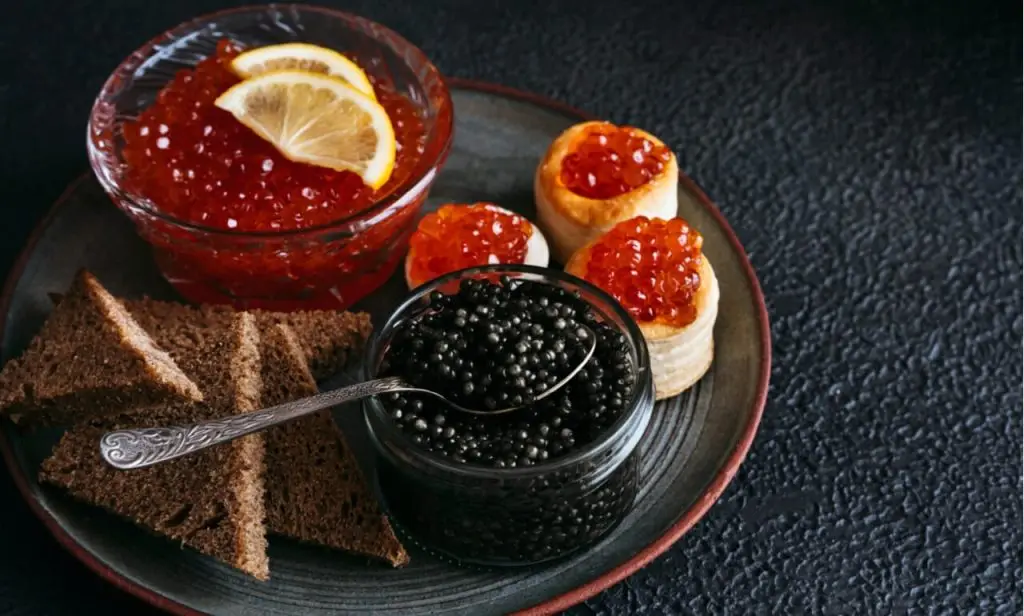
While caviar is a delicacy that is typically enjoyed on its own, there are popular accompaniments and garnishes that can enhance the experience. These include creme fraiche, lemon wedges, chopped hard-cooked eggs (separately yolks and whites), mini potatoes, minced onions, blinis, and lightly buttered toast points. However, it’s important to note that higher quality caviar is best savored in its pure form or paired simply with toast, blinis, or unsalted crackers.
When serving a variety of caviar types, it is customary to present them in order of taste intensity. Begin with the milder and more subtly flavored options, such as White Sturgeon, progressing towards the more robust and intense flavors of caviar, such as Sevruga. This sequence allows guests to fully appreciate the nuanced differences and progression of flavors as they indulge in the caviar selection.
Step-by-Step Guide to Serving Caviar
The following steps and tips allow you to present and serve the wonderful flavor of caviar so that it can be enjoyed:
Step 1:
1 hour prior to serving: Chill the serving plates in the refrigerator- as warm or hot plates will affect how long the caviar can sit out.
15-20 minutes prior to serving: Remove the caviar from the refrigerator and let the un-opened tin acclimate to room temperature. Do not open the container at this time.
Step 2:
Prepare your serving platter: Add traditional caviar accompaniments: bite-sized pieces of lightly-toasted triangles (and lightly buttered), blinis, shallots, etc.
Remove your bowl of crème fraiche from the refrigerator.
Step 3:
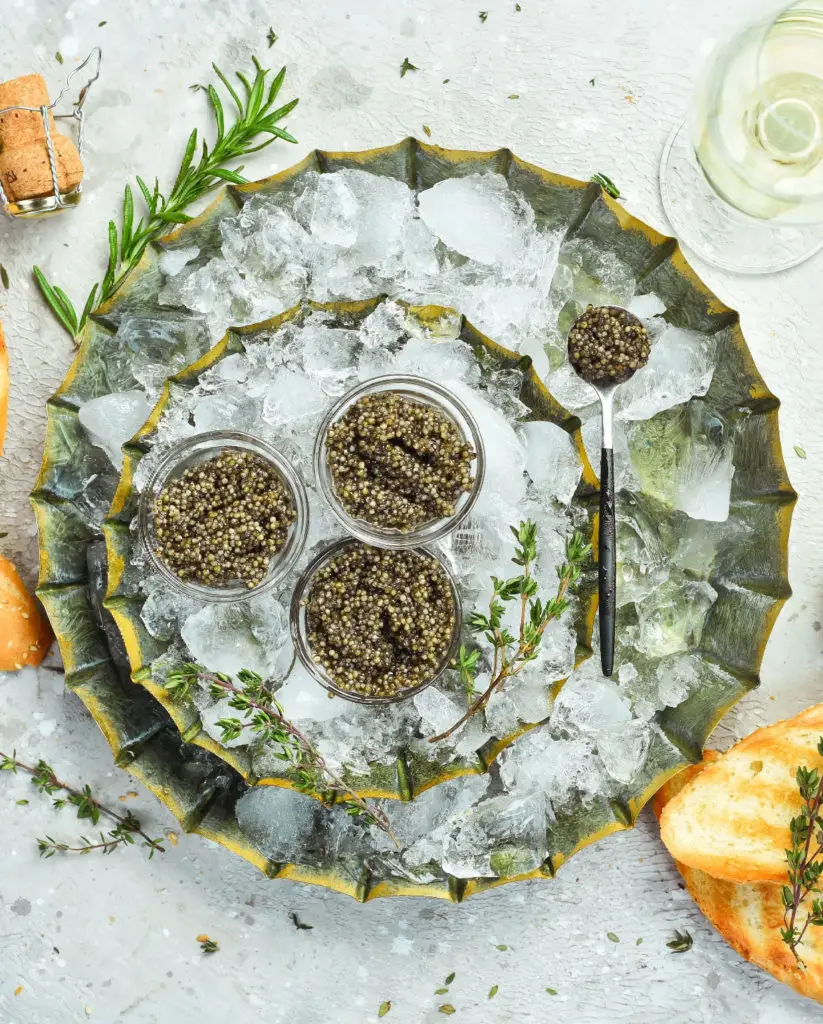
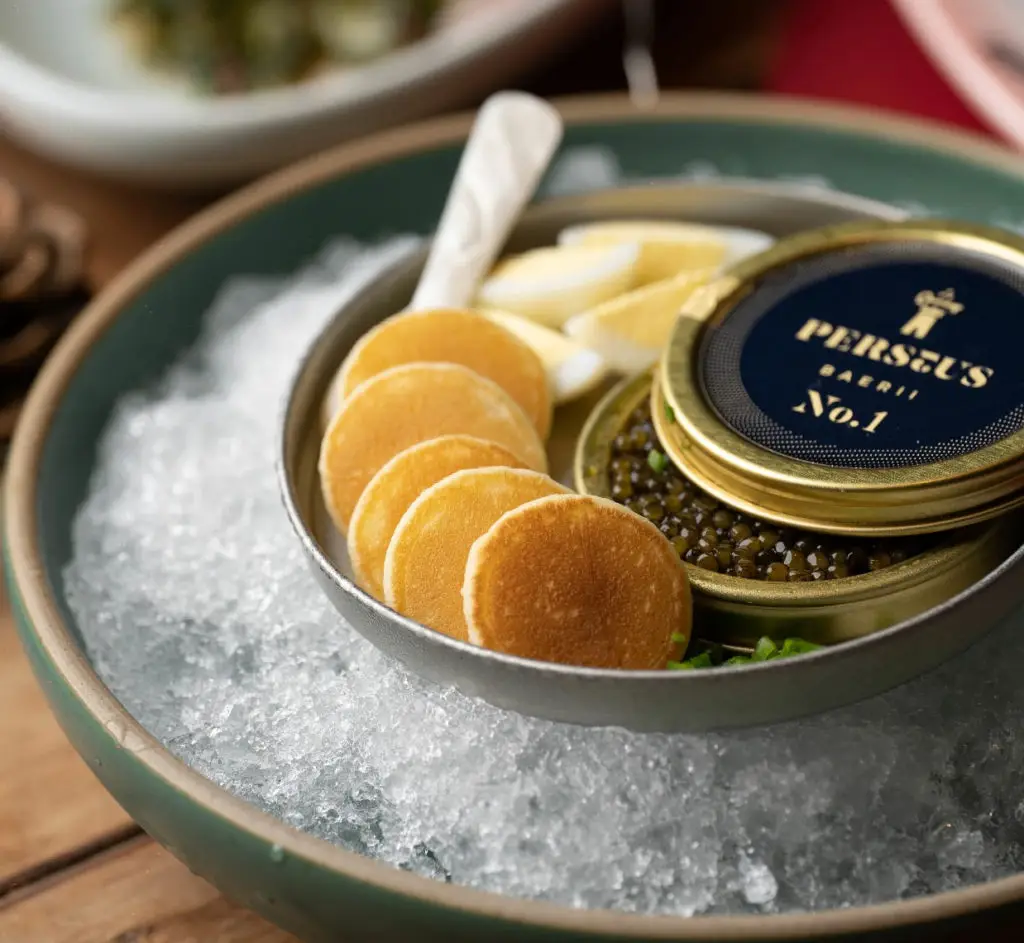
Add crushed ice to the caviar server (or decorative tray/dish -ideally made of silver or crystal).
Step 4:
Open the tin of caviar and place it on top the crushed ice ensuring the tin is completely surrounded by ice.
Add a mother-of-pearl spoon to the caviar. Note: If you do not have a mother-of-pearl spoon, a ceramic spoon (or bone, tortoise shell, and even wood) will suffice. Avoid using a metal or silver spoon as the metal may affect the flavor of the caviar.
Step 5:
Remove the chilled serving plates and place them along with the caviar tray and accompaniments on your serving table so guests can serve themselves.
Quick Serving Tips
- Handle Caviar with extreme care as the eggs are fragile.
- Rinse all non-sturgeon caviars prior to serving (in case the eggs have been dyed); this will prevent the color from running.
- To properly taste caviar, place the grains (eggs) into your mouth and let them burst forth on your tongue.
- Caviar can spoil quickly, so it is important to keep it nestled in crushed ice, and ideally- served and eaten immediately once opened.
- You should never cook caviar, as it will likely rupture the eggs. If a recipe calls for caviar, be sure to add it at the end, or as a garnish.
- If you are serving beverages with the caviar, the ideal choices are frozen vodka, and very dry Champagne (sparkling wine, or dry white wine may also be used). Avoid flavored vodkas or champagne that is sweet.
Serving Sizes For Caviar
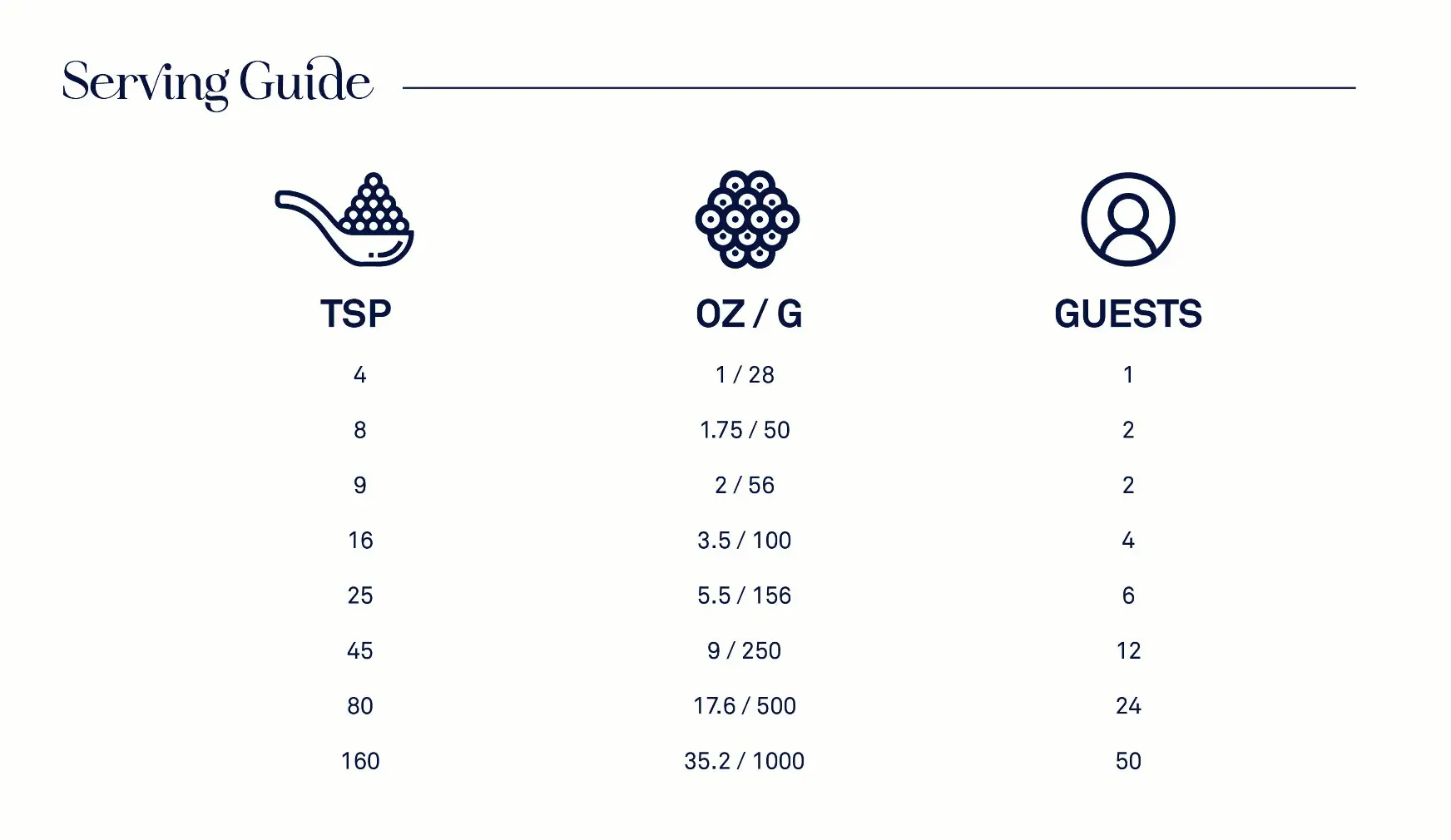
Allow at least 14 g (½ oz) to 28 g (1 oz) of caviar per person. Refer to the caviar serving chart below:
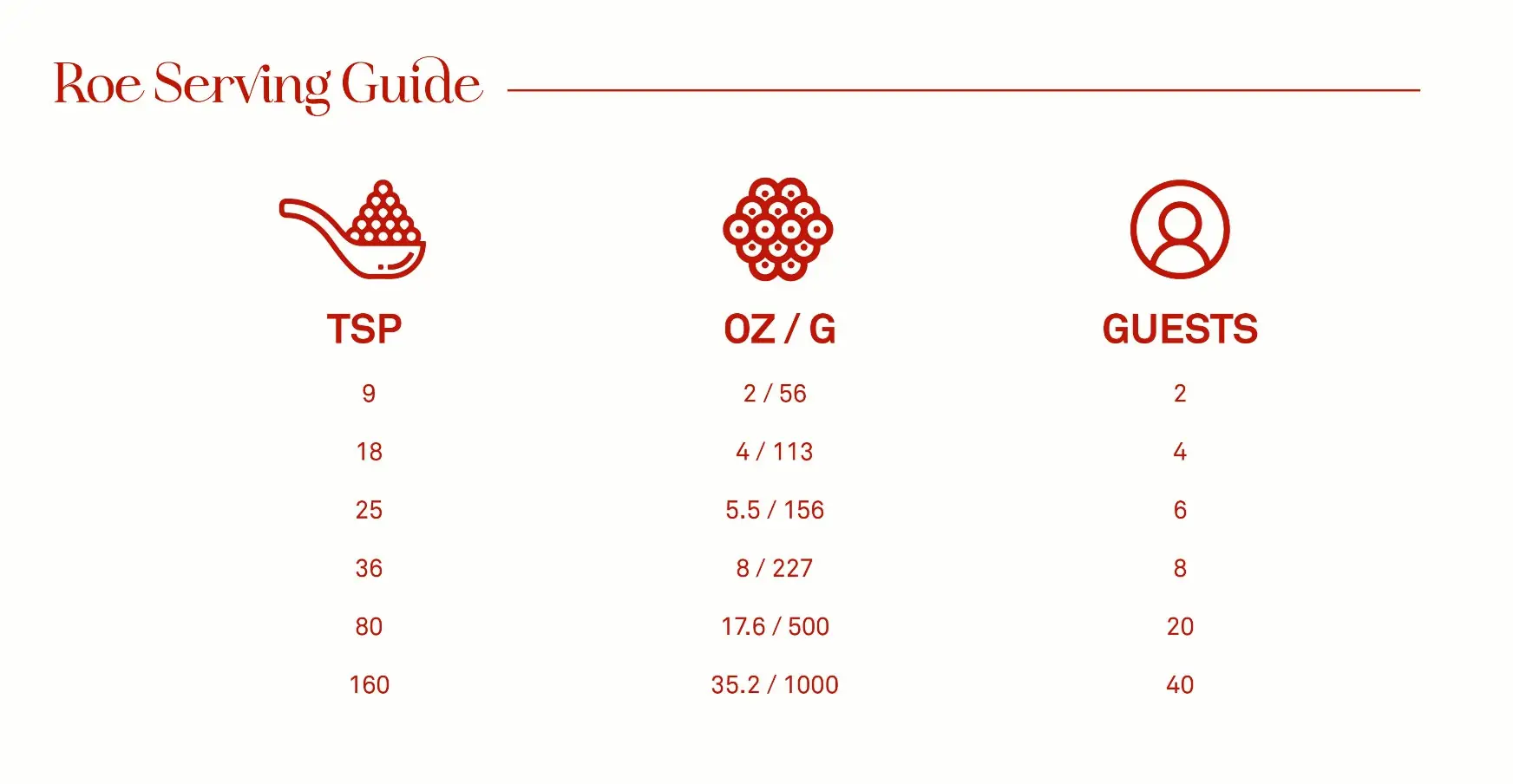
If you are looking to enjoy non-sturgeon roe, specifically, salmon roe, we recommend allowing for at least 28 g (½ oz) of caviar per person. Refer to the roe serving chart below:
Storing Caviar
To maintain the freshness and quality of caviar, it is crucial to store it correctly. Caviar should be kept refrigerated within a temperature range of 26-35°F (-3 to 2°C). When unopened, sturgeon caviar can be stored in the refrigerator for up to 6 weeks.
When it comes to serving caviar, minimizing exposure to air is essential. It is advisable to purchase caviar in smaller containers that can be consumed in a single sitting or caviar service. However, if you have leftover caviar, gently spread it flat with a mother-of-pearl spoon, ensuring that none of the eggs break. Cover the caviar with plastic wrap, pressing down lightly to remove any air trapped between the eggs and the cover. The remaining caviar should be consumed within the next 3 days to maintain its optimal flavor and texture.
Quick storage tips
- Refrigerate the caviar once you return from the store, but do not freeze (it may burst the eggs).
- Store fresh caviar at 26-34 degrees Fahrenheit. Caviar stored at this temperature can last 1-4 weeks and the high-oil content protects it from freezing at this temperature.
- If you are unsure of the temperature of your refrigerator, you can store the caviar in the fridge packed in ice (changing the ice as it melts).
- Caviar should only be opened immediately before it will be consumed.
- Unopened caviar can be refrigerated for 15-20 days.
- Opened caviar should be tightly covered with plastic wrap and eaten within 1-2 days.
Presenting Caviar
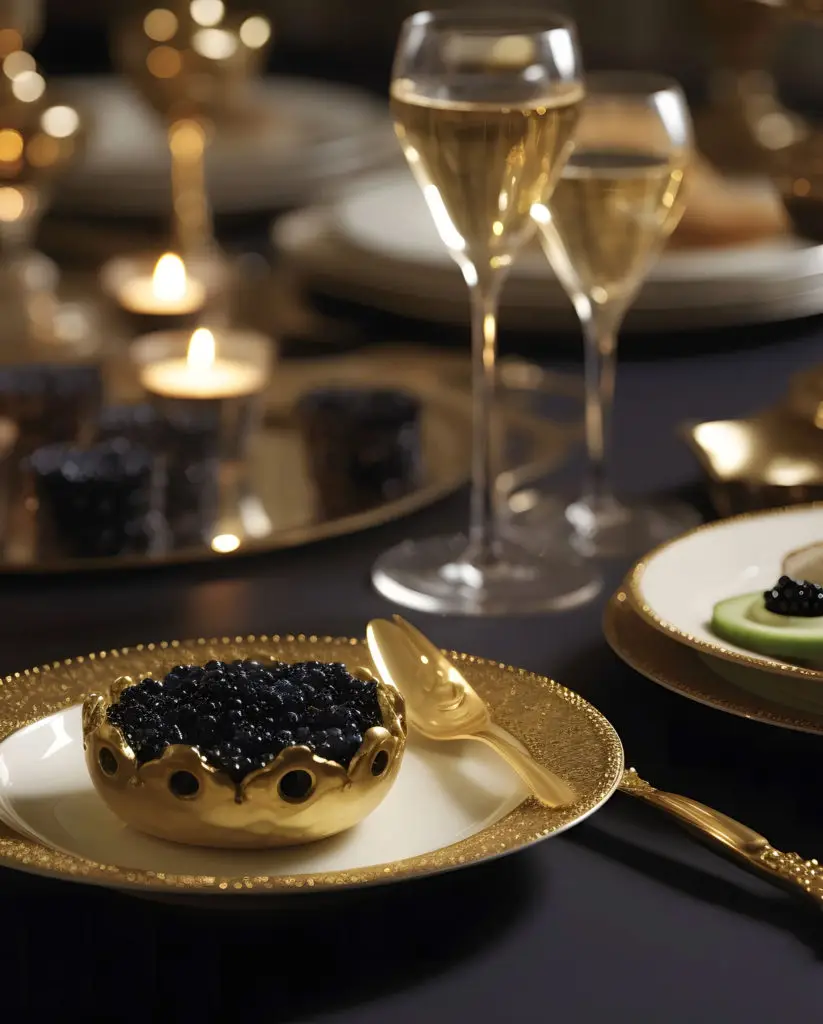
It’s worth noting that the presentation of caviar in traditional European settings can vary, particularly in terms of tableware and beverage pairings. In Russian culture, caviar is typically served in bowls made of metal, porcelain, or glass, without the use of ice. Guests are provided with special spoons featuring a blade shaped like a caviar spoon, often made of silver or gold-plated material. On the other hand, in European tradition, caviar is often presented in a dedicated caviar bowl placed on a bed of crushed ice inside a specific vase, creating an elegant display. In some cases, unique caviar bowls made from pearl shells may also be utilized, adding a touch of sophistication to the presentation.
Beverages To Pair With Caviar
Caviar presents an excellent opportunity to explore the world of alcoholic pairings. In traditional Ukrainian and Russian cuisine, caviar is often enjoyed alongside ice-cold vodka, creating a classic combination. However, in European culinary traditions, champagne and wine are often preferred companions for caviar, especially when served as a dessert. Furthermore, certain types of caviar can be enhanced by specific varieties of wines and sparkling wines. Here are some suggested combinations that are known to be perfect matches:
- Chardonnay & Beluga, Osetra, or White Sturgeon Caviar
- Cabernet Sauvignon & White Sturgeon Caviar
- Sauvignon Blanc & Golden Whitefish, Salmon, or Trout Caviar
- Brut & Any Black (Sturgeon) Caviar
- Blanc de Blanc & White Sturgeon, Salmon, or Trout Caviar
- Blanc de Noir & Beluga or Osetra Caviar
- Sparkling Rosé & Beluga or Osetra Caviar
- Pinot Noir & Salmon, Golden Whitefish, or White Sturgeon Caviar
- Rosé & Trout, Golden Whitefish Caviar, White Sturgeon, or Any Black (Sturgeon)
How Caviar is Served and Enjoyed
Caviar should always be served chilled, but it should never be frozen. Keeping caviar at room temperature can negatively impact its true taste and aroma. To ensure the optimal temperature throughout your meal and to preserve its authentic flavors, caviar should be presented on a bed of crushed ice. It is considered improper, and even impolite, to take large portions of caviar at once. When enjoying caviar at a social gathering or event, it is customary to consume smaller amounts, equivalent to or less than a tablespoon, to savor its delicate and distinct flavors. It is important to remember that caviar is not typically served as a main dish due to its intense flavor profile.
Incorporating it as a component of a larger dish may compromise the overall tasting experience and can be quite costly if used in large quantities. Therefore, it is recommended to serve black caviar as an appetizer or hors d’oeuvre, following the traditional serving approach.
When it comes to serving caviar, it is preferable to use mother of pearl spoons and forks. As previously mentioned, these non-metallic utensils prevent the caviar from oxidizing and acquiring a metallic taste. Additionally, bone, horn, glass, and wooden utensils are also acceptable. By using such materials, you can fully appreciate the intricate flavors and delicate aroma of the caviar, ensuring that your sense of taste is not compromised by any metallic undertones.
How Caviar is Served and Enjoyed
Understanding the caviar varieties:
Understanding the diverse array of caviar varieties is crucial for any discerning epicurean. For a comprehensive guide to deciphering the nuances of taste and texture inherent in different types of caviar, explore our detailed resource on caviar tasting and understanding caviar varieties in our blog. This guide serves as an invaluable tool for refining your palate and expanding your knowledge of this esteemed delicacy. Once you’ve honed your appreciation for caviar’s complexities, you can further enhance your culinary expertise by mastering the art of serving caviar with finesse and sophistication.